What is the DUCA Framework?
The DUCA Framework: Turning Human Intelligence and AI into Organizational Impact
Your organization may already have the expertise it needs to solve its most persistent challenges. The difficulty is connecting that expertise, applying it consistently, and measuring what changes.
A frontline employee understands why customers struggle with a process. Another department has developed a solution that could help. Leadership has set a clear strategic priority. Yet these pieces never come together—and the problem continues.
For large companies and government entities, this disconnect can slow transformation, weaken collaboration, and leave valuable employee knowledge underused. Adding artificial intelligence creates new opportunities, but realizing them requires an organizational approach that connects people, knowledge, and execution.
The DUCA Framework—Duverse Collective and Artificial Intelligence Framework— provides a structure for doing exactly that.
What Is the DUCA Framework?
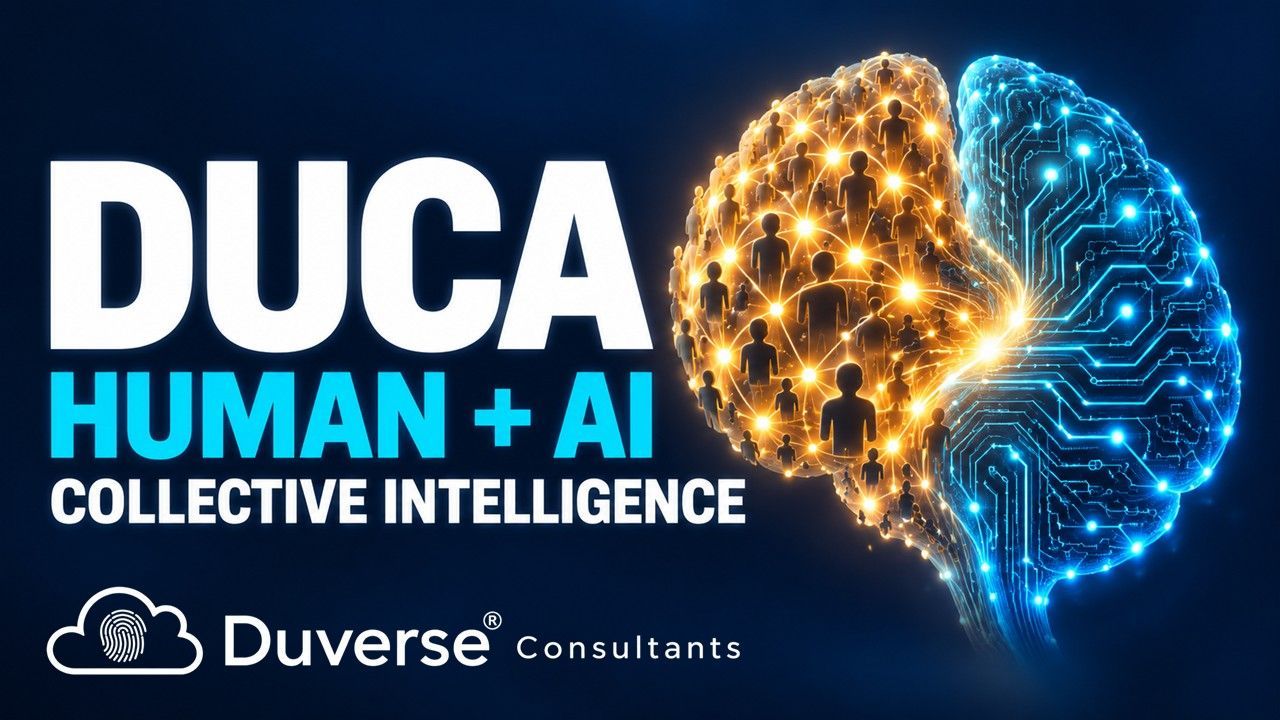
DUCA is an organizational intelligence and transformation framework designed to combine human collective intelligence with artificial intelligence.
Human collective intelligence brings together the experience, judgment, creativity, and problem-solving capabilities of employees and teams. AI can support this process by helping people access information, identify patterns, locate expertise, and develop insights.
DUCA connects these capabilities through three pillars:
- Seek knowledge: Understand challenges, discover insights, and develop relevant capabilities.
- Share knowledge: Make expertise accessible and enable collaboration across organizational boundaries.
- Implement knowledge: Translate learning and ideas into decisions, improvements, and measurable outcomes.
The framework applies these pillars at the individual, departmental, and organizational levels, connecting leadership priorities with contributions from employees.
Why Organizations Need a More Connected Approach
Many organizations invest separately in learning, knowledge management, innovation, performance management, and AI adoption. Each initiative can deliver value, but their impact depends partly on how well they work together.
Training may build knowledge without creating opportunities to apply it. Innovation programs may generate ideas without a clear route to implementation. Knowledge platforms may hold valuable information that employees struggle to find. AI tools may accelerate tasks while leaving the underlying process unresolved.
DUCA helps organizations examine these connections. It asks practical questions: What do people need to learn? Who needs access to that knowledge? How will it inform action? What evidence will show whether the action helped?
These questions connect investment in people and technology to the outcomes the organization wants to achieve.
The Three Pillars of DUCA
1. Seek Knowledge: Understand Before Acting
Effective transformation starts with understanding the challenge.
DUCA encourages organizations to combine operational evidence with employee experience, customer or citizen feedback, and relevant external knowledge. This helps teams identify capability gaps, question assumptions, and investigate the causes of recurring problems.
AI can support this work by organizing feedback, analyzing records, or helping employees retrieve relevant information. Human judgment remains essential to interpret findings and determine their significance.
The objective is to build the knowledge needed for a sound decision.
2. Share Knowledge: Make Expertise Available Where It Matters
Expertise creates greater value when others can access and apply it.
DUCA focuses on how knowledge moves between people, departments, and leadership. This includes documenting lessons, connecting specialists, developing communities of practice, and enabling cross-functional problem-solving.
Technology can make knowledge easier to retrieve. The organization also needs clear ownership, time for collaboration, and a culture in which useful contributions receive recognition.
The objective is to turn individual experience into shared organizational capability.
3. Implement Knowledge: Connect Insight to Results
Learning becomes valuable when it informs action.
DUCA connects insights and ideas with defined responsibilities, practical experiments, implementation decisions, and outcome measurement. Teams establish what they intend to improve, test an intervention, and review the evidence before expanding it.
The objective is to create a repeatable path from knowledge to measurable value.
Connecting Leadership Direction with Employee Insight
DUCA works through two complementary directions.
Top-down alignment connects leadership priorities with departmental objectives and everyday decisions. Employees understand the outcomes that matter and the boundaries within which they can act.
Bottom-up contribution brings operational knowledge, ideas, and problem-solving from employees into organizational decision-making. Teams can surface challenges, propose improvements, and provide evidence that helps leadership refine its approach.
Together, these flows support a continuing conversation between strategy and practical experience. Leadership provides direction, while employees contribute the knowledge needed to make that direction work.
What DUCA Could Look Like in Practice
Consider a government entity seeking to reduce application processing times.
Leadership defines the desired outcome. Frontline employees identify recurring difficulties, such as unclear instructions and repeated requests for missing documents. Policy, operations, and technology teams investigate the issue together.
AI could help organize service records and identify common patterns. Employees validate those findings and explain the operational context.
The teams then develop clearer guidance and an earlier document check. They test the changes and measure processing time, repeat submissions, and user feedback.
This illustrative example follows the DUCA cycle: seek knowledge, share knowledge, implement knowledge, and review impact. It also creates lessons that other services may be able to use.
Measuring Contribution Beyond Individual Targets
An employee’s contribution can extend beyond their own results.
Someone who helps another team solve a problem, shares a useful method, or supports colleagues in developing a capability may create value across the organization. Conventional performance measures do not always capture that contribution clearly.
DUCA introduces Universal Collective Impact Behavior, or UCIB, to examine how individuals and departments contribute to collective progress.
Its proposed measurement mechanism, the Universal Collective Impact Behavior Index, or UCIBI, is intended to track relevant indicators of contribution and impact.
Implementation requires careful design. Indicators should reflect the organization’s responsibilities, recognize shared effort, and connect activity with evidence of value. Scoring methods need testing and review before they inform consequential decisions.
The purpose is to make meaningful collective contribution more visible and support better development conversations.
Where AI Adds Value
Within DUCA, AI supports organizational learning and decision-making across the three pillars.
Depending on the organization’s needs and available systems, applications could include:
- Helping employees find relevant information and expertise.
- Identifying knowledge and capability gaps.
- Summarizing lessons from completed projects.
- Supporting tailored learning recommendations.
- Analyzing recurring operational challenges.
- Connecting related ideas and improvement initiatives.
Effective use depends on reliable information, appropriate access, clear governance, and human review. These conditions should be considered from the beginning of implementation.
Is DUCA Relevant to Your Organization?
DUCA may be particularly relevant if your organization is experiencing:
- Repeated problems across departments.
- Valuable expertise concentrated in a few individuals.
- Learning programs with limited evidence of workplace application.
- Innovation initiatives that struggle to reach implementation.
- A gap between strategic priorities and frontline experience.
- AI adoption that needs stronger connections to business outcomes.
For government entities, potential applications include service improvement, institutional knowledge retention, and workforce development.
For large companies, potential applications include cross-functional collaboration, operational improvement, transformation delivery, and the wider adoption of useful innovations.
The starting point is a specific organizational challenge with an outcome that can be assessed.
Start with a Focused DUCA Pilot
A practical first step is to select one process, service, or capability that needs improvement.
Define the current situation and the desired outcome. Bring together the people who understand the challenge. Identify what they need to learn, how they will share that knowledge, and which improvement they can test.
A focused pilot allows the organization to assess both the operational results and the behaviors that helped produce them. Those findings can guide decisions about wider implementation.
Explore DUCA with Duverse Consultants
If your organization is investing in people, transformation, or AI, the next question is how those investments connect to shared capability and measurable results.
Contact Duverse Consultants to arrange an introductory DUCA consultation.
Bring one recurring organizational challenge. We can explore how the framework could structure a focused pilot, which stakeholders should participate, and what evidence would help you assess its value.
Turn your organization’s knowledge into collective capability—and collective capability into action.